
AI call automation · 14 Aug 2026 · 13 min read
AI Receptionist for Pest Control Companies: A Practical Booking Guide
How pest-control companies can use an AI receptionist to answer missed calls, qualify enquiries, book inspections and route urgent cases without overpromising.
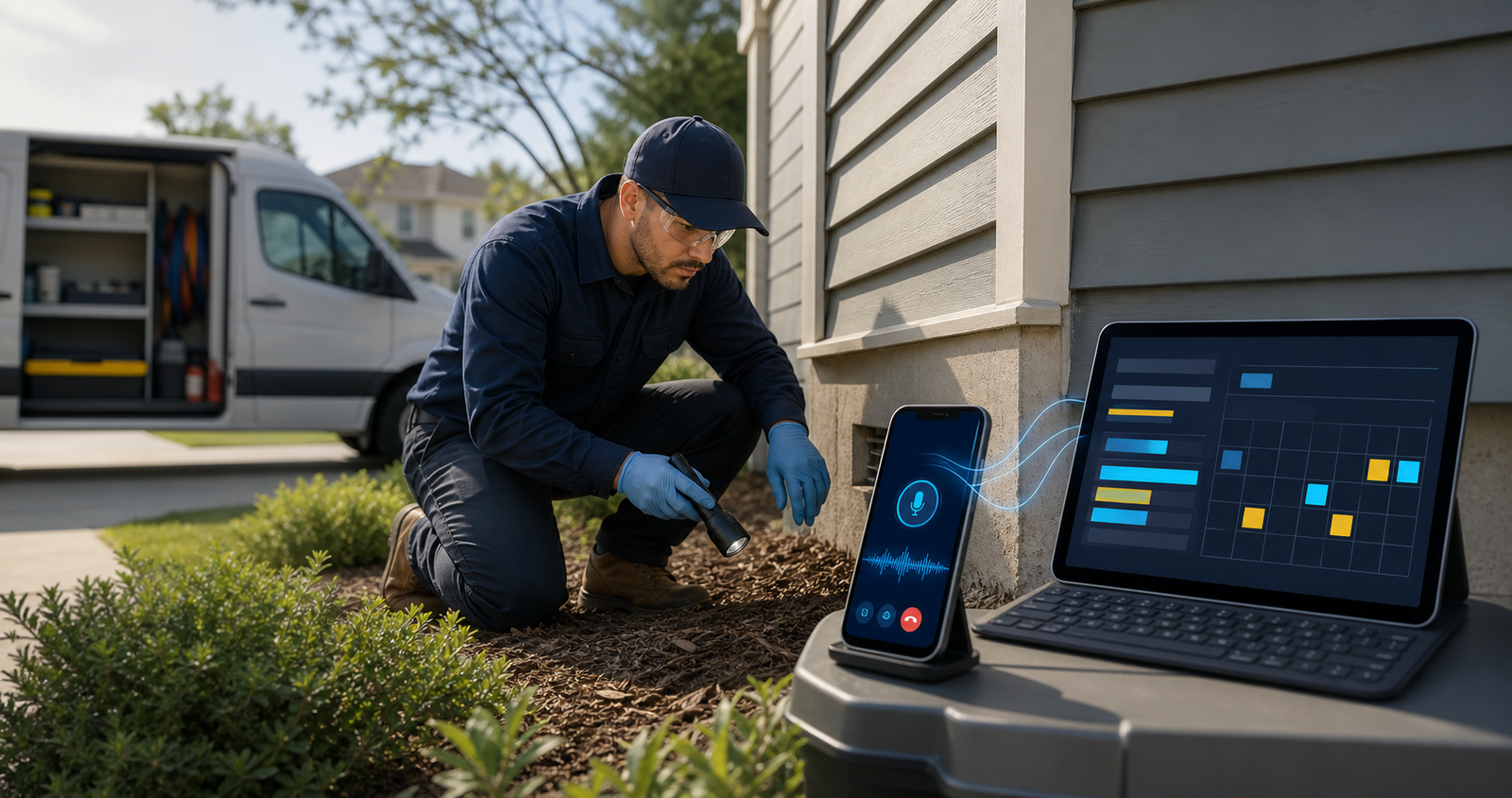
A homeowner who finds bed bugs, hears scratching in a wall or discovers a wasp nest does not usually submit three forms and wait patiently. They call. If the first pest-control company reaches voicemail, they often try the next result.
The person expected to answer may be driving between jobs, wearing protective equipment, inspecting a loft or speaking with the customer already paying for their time. That makes pest control an unusually natural market for an AI receptionist: the phone demand is urgent, repetitive enough to structure and closely connected to appointment availability.
This guide explains how a pest-control company can use Botphonic to answer routine calls, collect useful details, book the right next step and escalate conversations that need human judgement. It also covers where an AI call bot should stop, what to test before launch and how to measure whether it creates real booked work rather than impressive-looking call volume.
Why pest control is a promising long-tail niche
The broad phrase "AI receptionist" is crowded with horizontal software vendors. Pest-control search intent is more focused. Relevant clusters include:
- AI receptionist for pest-control companies;
- pest-control answering service;
- 24/7 answering service for exterminators;
- pest-control appointment-booking software;
- how to stop missing pest-control calls;
- after-hours pest-control call answering.
Current results show established interest in call-answering services, but only a relatively small group of pages explains AI deployment specifically for pest-control workflows. That creates an opportunity between a proven service category and a newer product category. This is directional evidence of demand, not a claim of a precise monthly keyword volume.
Industry publication Pest Control Technology has described phone calls as a primary source of new bookings and the commercial damage caused by missed calls. FieldRoutes also maintains a dedicated comparison of pest-control answering services. Those are strong signals that operators actively research and buy solutions to this problem.
What Botphonic currently offers
Botphonic is a configurable AI voice-agent platform rather than a pest-control field-service system. Its current product information lists inbound call handling, appointment booking, call routing, information extraction, custom workflows, multilingual conversations and connections to CRMs and business tools.
Published integrations include Salesforce, HubSpot, Zoho and Zapier, with REST APIs available for other workflows. Its AI receptionist page also describes Google Calendar scheduling, customizable greetings and escalation rules, and a Knowledge Hub that can use approved company information.
Botphonic currently advertises support for more than 20 languages. The Starter plan includes 50 minutes, five concurrent calls, unlimited assistants and API access. The Pro plan includes 120 minutes, up to 25 concurrent calls, custom workflows and batch campaigns. The published pricing page offers a 14-day trial with 20 trial minutes and a refundable $1 verification charge. Check the official page before purchasing because prices and allowances can change.
Where an AI receptionist fits in a pest-control business
| Call type | Suitable AI action | Boundary |
|---|---|---|
| New residential enquiry | Collect caller, address, pest type and preferred time; offer an inspection slot | Do not promise treatment outcome or final price without enough information |
| Outside service area | Check postcode against approved coverage and record the lead | Do not invent an exception or book an uneconomic route |
| Existing booking | Confirm, request a reschedule or capture an access note | Respect same-day cut-offs and technician route constraints |
| Recurring customer | Identify account and route service-plan questions | Do not change contractual terms without authorization |
| Commercial or property-manager lead | Capture site count, location, pest issue and decision timeline | Escalate tenders, compliance documents and negotiated pricing |
| Possible exposure or safety concern | Use a pre-approved escalation message and transfer promptly | Never diagnose symptoms or provide improvised medical or pesticide advice |
| Complaint | Listen, summarize and alert the responsible manager | Do not admit liability, argue or offer unauthorized compensation |
The best first deployment: missed and after-hours inbound calls
Do not begin by replacing every phone interaction. Forward unanswered calls after a sensible ring period and route calls outside staffed hours to the AI. This lets customers reach a responsive system while the existing team retains first access during the day.
An initial agent should perform five jobs well:
- Identify the business and make clear that the caller is speaking with an automated assistant.
- Collect the caller's name, callback number and service address.
- Understand the broad pest problem without attempting technical diagnosis.
- Check service-area and booking rules.
- Book an approved slot, schedule a callback or transfer the call.
That narrow scope is easier to test and safer than giving the bot authority over quotations, chemical recommendations, contracts and every exceptional case.
Build a pest-control call flow
1. Open with clarity
Use a greeting such as:
Thank you for calling Riverside Pest Control. I am the automated booking assistant. I can help check your service area, collect details and arrange an appointment, or transfer you when a team member is available.
Avoid pretending the bot is a human employee. Clear expectations make transfers and limitations feel deliberate rather than deceptive.
2. Confirm identity and contact details
Ask for the caller's name, telephone number and service postcode. Read back important information. If the transcription confidence is low, ask again rather than saving a plausible but incorrect address.
3. Classify the enquiry
Use a short approved list such as:
- ants, cockroaches or crawling insects;
- wasps, hornets or bees;
- rodents;
- bed bugs or fleas;
- termites or wood-destroying insects;
- wildlife or bird-control enquiries;
- commercial inspection;
- existing appointment, invoice or recurring-service question;
- something else requiring a callback.
The purpose is routing, not species identification. The agent should not state that a pest is harmless, confirm an infestation or prescribe a treatment from a telephone description.
4. Capture useful qualification details
Depending on the service, ask where the activity was seen, how long it has been present, whether access is available and whether the property is residential or commercial. Ask only questions the company genuinely uses to schedule or prepare.
Children, pets, allergies, bites, stings or possible chemical exposure may affect escalation. Configure the AI to pass these cases to a trained person or direct the caller to the appropriate emergency resource under a reviewed script. It should not provide health advice.
5. Apply service-area rules
Load approved postcodes, excluded locations, travel charges and any commercial-only territories. A booking agent that fills the calendar with jobs the company cannot serve creates more work than voicemail.
6. Offer the correct appointment type
Do not expose every empty calendar slot. Define durations and buffers for inspections, routine treatments, termite work, commercial surveys and callbacks. Respect route days, technician skills and preparation requirements.
7. Confirm the outcome
Repeat the date, arrival window, address and next step. Write the structured summary to the connected calendar, CRM or notification workflow. The customer should know whether the appointment is confirmed or merely requested.
What belongs in the Botphonic Knowledge Hub
Give the voice agent a controlled source of truth:
- business name, opening hours and genuine after-hours coverage;
- service postcodes and geographic exclusions;
- services offered and pests not handled;
- approved price ranges or inspection-fee language;
- appointment durations, buffers and cancellation rules;
- preparation instructions that have been reviewed by a qualified operator;
- commercial, landlord and property-manager routing rules;
- human transfer numbers and escalation hours;
- privacy, recording and disclosure wording;
- phrases the agent must never use.
Do not upload an unreviewed website and assume every sentence is suitable for live calls. Old opening hours, vague guarantees and promotional language can become operational promises when spoken by an automated agent.
Set strict pricing boundaries
Simple services may have approved starting prices or inspection fees. Complex jobs depend on property size, access, severity, treatment type, repeat visits and local rules. Configure one of three responses:
- Fixed approved price: only where the business genuinely sells that service at a fixed amount.
- Qualified range: explain what the range covers and that the final quotation follows inspection.
- No phone quotation: book an inspection or arrange a specialist callback.
The agent should never negotiate, invent discounts or guarantee eradication unless the company has explicitly approved the exact language and conditions.
Create sensible escalation rules
Transfer or alert a person when:
- the caller reports breathing difficulty, severe reaction, poisoning or immediate danger;
- a vulnerable person or animal may have been exposed;
- the caller is highly distressed or repeatedly asks for a person;
- the situation involves a school, food facility, healthcare site or major commercial account;
- the pest or service is outside the approved knowledge base;
- the caller disputes a charge, threatens legal action or makes an insurance claim;
- the calendar or integration is unavailable;
- speech recognition repeatedly fails.
Always provide a fallback. If the transfer fails, capture a verified callback number, mark the priority and tell the caller what will happen next.
Botphonic integrations for a pest-control workflow
A practical setup usually connects four layers:
- Telephone routing: the existing business number forwards overflow or after-hours calls.
- Botphonic: handles the conversation, qualification, booking and summary.
- Calendar or CRM: stores the lead, appointment and conversation outcome.
- Team notification: sends urgent transfers and failed-booking tasks to the right person.
Botphonic lists Google Calendar, Salesforce, HubSpot, Zoho, Zapier and REST API connectivity. If the pest-control business uses a specialist field-service platform, verify the exact connection path and which system remains authoritative for technician availability. A generic calendar integration is not automatically the same as full route optimization.
Inbound answering versus outbound AI calls
Inbound calls are the safer starting point because the customer initiated the conversation. Botphonic's Pro plan also supports batch campaigns, which could be used for renewal reminders, lapsed estimates or service-plan outreach. Treat that as a separate project with its own legal review.
In the United States, the FCC has confirmed that AI-generated voices fall within TCPA restrictions on artificial or prerecorded voices. The FTC's Telemarketing Sales Rule also contains consent, Do Not Call, caller-identification, time-of-day, recordkeeping and opt-out requirements. State laws may add further obligations, and other countries have their own rules.
Do not upload an old customer list and start automated sales calls simply because the software permits batch calling. Determine whether the purpose is informational or promotional, document the applicable consent, honour revocation and suppression requests, and obtain qualified legal advice for the campaign and territories involved.
Recording, disclosure and customer trust
Call-recording consent rules vary by location. Decide whether calls are recorded or transcribed, provide the required notice, restrict access and set a retention period. Do not collect payment-card details or other sensitive information unless the complete workflow is designed and approved for it.
Tell callers they are speaking with an automated assistant. Provide a human route. Review transcripts for misunderstandings, but remove unnecessary personal information from testing and training datasets.
A 30-day Botphonic pilot
Week 1: baseline and design
Measure inbound calls by hour, answered calls, missed calls, qualified enquiries and bookings. Listen to a representative sample. Document the ten most common call reasons, service-area rules and escalation cases.
Week 2: build and test
Create the knowledge base and short call flow. Use staff to test accents, background noise, interruptions, vague pest descriptions, repeated questions, wrong postcodes, no available appointments and transfer failures.
Week 3: limited launch
Route only after-hours or unanswered calls from one line. Review every call daily. Keep booking authority narrow and require human confirmation for unusual services while the team learns where errors occur.
Week 4: measure and refine
Compare the pilot with the baseline. Correct knowledge gaps, shorten repetitive questions and adjust escalation. Expand coverage only when customers receive accurate outcomes and the operations team trusts the records.
Metrics that show whether the AI receptionist works
| Metric | Question it answers |
|---|---|
| Answer rate | Did fewer genuine callers reach voicemail? |
| Qualified-call rate | How many calls matched the service area and offered work? |
| Booking rate | How many qualified callers received a confirmed appointment? |
| Transfer success | Did urgent or complex callers reach the correct person? |
| Scheduling accuracy | Were service type, duration, address and availability recorded correctly? |
| Caller abandonment | Where did callers hang up or become frustrated? |
| Human correction rate | How often did staff need to repair the summary or booking? |
| Cost per booked job | Did recovered gross profit justify software and call costs? |
Do not optimize for containment alone. A short human transfer can be a successful outcome; a fully automated call that books the wrong service is not.
Calculate a realistic return
Use conservative inputs:
Monthly recovered gross profit = missed qualified calls answered by AI x booking rate x completion rate x average gross profit per completed job.
Subtract the subscription, additional call costs, integration cost, staff review time and the value of errors. Run low, expected and high scenarios. If the result depends on every answered call converting, the business case is not credible.
Botphonic's low published entry price makes a small pilot accessible, but the included minutes are limited. Estimate call duration and seasonal volume before choosing a plan. Ask what happens when included minutes or concurrent-call limits are reached.
Botphonic versus voicemail and human answering
| Option | Strength | Trade-off |
|---|---|---|
| Voicemail and callback | Simple, familiar and inexpensive | No live qualification or booking; urgent callers may continue searching |
| AI receptionist | Immediate, scalable and consistent for structured calls | Needs careful knowledge, testing, disclosure and escalation |
| Human answering service | Better judgement and empathy for unusual conversations | Usually higher cost and quality varies by agent and training |
| Hybrid coverage | Humans handle priority calls while AI covers overflow and routine intake | Requires clear routing and ownership between systems |
Who should consider Botphonic?
Botphonic is worth testing for owner-operated pest-control companies missing calls in the field, growing teams that need after-hours coverage, multi-location operators with seasonal call spikes and agencies building structured voice workflows for local-service clients.
It is less suitable when nearly every call requires specialist judgement, the company has no reliable calendar or service-area data, staff cannot review early conversations, or the business expects an AI agent to replace field-service software and route planning.
The best implementation does not ask whether a bot can talk. It asks whether the complete system produces accurate, safe and profitable customer outcomes.
Research sources
- Botphonic AI receptionist features.
- Botphonic plans, allowances and trial details.
- FieldRoutes pest-control answering-service guide.
- Pest Control Technology on missed-call operations.
- FCC ruling on AI-generated voices and the TCPA.
- FTC guidance on the Telemarketing Sales Rule.
Frequently asked questions
Can an AI receptionist book pest-control appointments?
Yes. A configured agent can collect the caller's details, check approved service-area and scheduling rules, and offer suitable calendar slots. Complex jobs and unusual services should remain subject to human confirmation.
What should a pest-control call bot ask?
Useful questions include the caller's name, callback number, service address, broad pest category, where activity was noticed, property type and preferred appointment time. Ask only for information used in routing, preparation or booking.
Should an AI receptionist quote pest-control prices?
Only use fixed prices or qualified ranges that the company has explicitly approved. Where price depends on inspection, property, severity or treatment, arrange an inspection or specialist callback instead of inventing a quotation.
Can an AI call bot provide pest or pesticide safety advice?
It should not improvise medical, toxicological or pesticide advice. Use reviewed scripts to transfer safety-sensitive calls and direct immediate emergencies to appropriate professional or emergency resources.
Does Botphonic integrate with calendars and CRMs?
Botphonic currently advertises Google Calendar scheduling and integrations involving Salesforce, HubSpot, Zoho, Zapier and REST APIs. Verify the exact connection needed for any specialist pest-control field-service platform.
How much does Botphonic cost?
Botphonic currently publishes Starter and Pro monthly plans based on included call minutes and concurrent calls, plus custom Enterprise pricing. It also advertises a 14-day trial. Check the official pricing page because allowances and prices can change.
Are outbound AI sales calls legal?
Rules depend on the caller, recipient, purpose, technology and jurisdiction. In the United States, AI-generated voices fall within TCPA restrictions, while FTC rules also address consent, Do Not Call, disclosure, calling times, records and opt-outs. Obtain qualified advice before launching outbound campaigns.