
Pet ecommerce · 21 Aug 2026 · 15 min read
Google Shopping for Pet Stores: A Profit-First Pricing and PPC Guide
A practical Google Shopping guide for online pet stores: monitor competitor prices, protect product margins and improve PPC with Pricefy and Adalysis.
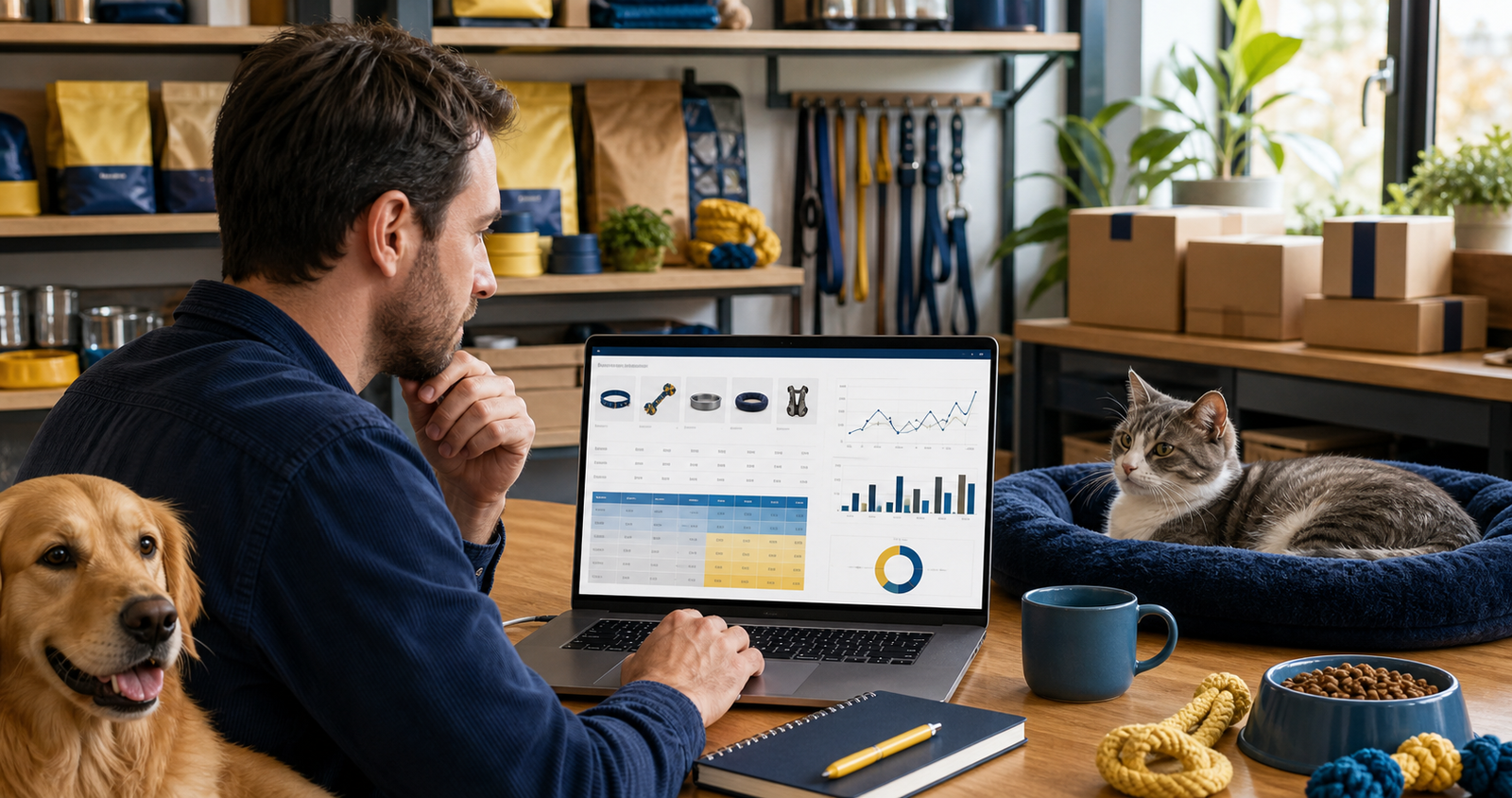
Google Shopping is a natural acquisition channel for an online pet store. A shopper can see the product, brand and price before clicking, which works well for recognisable bags of food, flea treatments, beds, carriers, grooming products and repeat-purchase supplies. It also creates a hard commercial problem: the price is visible next to competitors before the store pays for the visit.
That makes Google Shopping for pet stores more than an advertising exercise. A campaign can report a healthy return on ad spend while pushing products whose delivery cost, discount and cost of goods leave almost no contribution profit. The opposite can happen too: a well-priced, high-margin product may receive too little budget because account management is organised around blended revenue rather than commercial value.
This guide joins the two sides of the decision. Pricefy is used for competitor price monitoring, matching and controlled repricing. Adalysis is used for Google Ads audits, alerts, budget pacing and Performance Max analysis. They do different jobs, and many smaller retailers will need only one at first. Together, however, they provide a useful operating model: know the margin before buying the click, then monitor the ads against that margin.
Why online pet stores are a strong niche for this workflow
The audience is commercially substantial. The American Pet Products Association reported $158 billion in U.S. pet-industry expenditure in 2025 and projects $165 billion for 2026. Food and treats account for the largest share, while supplies, live animals and over-the-counter medicine are also a major category. Demand is broad, but the operational pattern is unusually specific:
- Many products are directly comparable. Shoppers can compare the same branded food, supplement, collar or filter across several retailers.
- Repeat purchases amplify small decisions. Winning a profitable first order for food, litter or parasite control may create recurring value, but over-discounting every repeat can quietly destroy it.
- Pack size matters. A 2 kg bag, 10 kg bag, multipack and subscription offer are not equivalent, even when product titles look similar.
- Fulfilment cost varies sharply. Heavy litter and food can generate revenue while contributing less profit than a lightweight accessory with a lower selling price.
- Seasonality moves by category. Flea and tick products, cooling mats, travel accessories, coats, gifts and calming products do not share one demand curve.
Search results for pet-store PPC and ecommerce pricing contain agencies, broad marketing lists and isolated case studies. There is less practical content explaining how a specialist retailer can connect competitor pricing to Shopping economics. That is the long-tail opportunity this guide targets: Google Shopping for pet stores, pet store pricing strategy, pet supplies competitor price monitoring and profitable Performance Max for pet products.
Pricefy vs Adalysis at a glance
| Question | Pricefy | Adalysis |
|---|---|---|
| Primary job | Competitor price monitoring, product matching, repricing and product feeds | PPC auditing, monitoring, analysis, budget management and automation |
| Data it works from | Your catalogue and matched competitor listings | Connected Google Ads and Microsoft Ads accounts |
| Pet-store question it answers | Are we competitively priced without crossing our margin floor? | Are campaigns spending efficiently and behaving as expected? |
| Best initial use | Track a controlled set of identical, price-sensitive SKUs | Automate recurring audits and alerts on a meaningful ad account |
| Does it replace Merchant Center? | No, although Pricefy offers product-feed capabilities | No |
| Does it calculate true order profit automatically? | Not by itself; your rules still need reliable cost and margin inputs | Not by itself; Google Ads data must be reconciled with commerce costs |
The comparison is therefore not “which product is better?” Pricefy manages market-price intelligence. Adalysis manages paid-search operations. A pet retailer should buy the layer associated with its current constraint rather than collecting software without a clear decision process.
Start with contribution margin, not ROAS
Return on ad spend is revenue divided by advertising cost. It is useful, but it does not know whether a sale contains a heavy bag of food, a high-margin private-label supplement or a deeply discounted branded bed. Build a simple contribution model before changing prices or budgets:
Contribution before advertising = selling price − product cost − payment fee − pick and pack − shipping subsidy − expected discount − expected returns cost.
Contribution after advertising = contribution before advertising − allocated ad cost.
For example, imagine a product sells for £50. Product and fulfilment costs total £35, leaving £15 before advertising. If the click-to-sale acquisition cost is £10, only £5 remains. A reported 5x ROAS sounds strong because £50 revenue came from £10 ad spend, but the commercial cushion is thin. Reducing the price by £3 to match a competitor would remove 60% of the remaining contribution unless conversion rate or repeat value improves.
This is why automated repricing must use a floor and paid media must use category-appropriate targets. Neither a competitor's price nor a platform's recommended budget knows your complete economics.
Segment the pet catalogue before monitoring prices
Do not apply one rule to the entire catalogue. Create commercial groups that reflect why a shopper buys and how the order makes money:
- Known-value repeat essentials: branded food, litter, filter media and routine care products that shoppers compare frequently.
- Traffic drivers: recognisable products that introduce customers to the store but may carry modest first-order margin.
- Margin builders: accessories, bundles, private-label items and add-ons with less direct price comparability.
- Bulky or fragile goods: large beds, cages, aquariums and heavy consumables where delivery changes the economics.
- Seasonal products: cooling, travel, parasite control, coats, calming products and gifting lines.
- Clearance and end-of-line stock: products managed for cash recovery rather than normal margin.
Add stable labels to the store catalogue and Merchant Center feed. Useful labels include commercial group, margin band, repeat-purchase potential, stock cover and season. The exact naming matters less than using the same classification in pricing reports, analytics and campaign structure.
How to use Pricefy for pet-supply competitor monitoring
Pricefy currently says it can monitor competitor prices across countries, currencies and marketplaces including Amazon and eBay. Its matching process uses identifiers such as EAN, GTIN and UPC before falling back to text and visual comparison. It integrates with Shopify, WooCommerce, Magento, BigCommerce, PrestaShop and Wix, with an API route for custom setups.
Those capabilities suit branded pet catalogues, but product matching still requires judgement. A pet retailer should use this sequence:
1. Prove matching quality on one category
Start with 25 to 50 products in a category where identical references are sold by several competitors. Dog food, aquarium consumables or branded grooming tools are better test sets than handmade accessories. Pricefy currently offers a free plan for up to 50 SKUs and five competitors, making a small validation project possible without automating the entire shop.
2. Verify the comparison unit
Check brand, formula, size, flavour, life stage, variant, pack quantity and condition. Compare effective unit price where appropriate. A competitor selling six tins is not cheaper than a twelve-tin case merely because the displayed number is lower. The same warning applies to bundles with free gifts or loyalty-only discounts.
3. Compare the delivered proposition
Record whether the rival is in stock, whether its price excludes delivery, and whether the product qualifies for a free-shipping threshold. A £1 lower item price can be irrelevant when the total delivered cost is higher. Price is one part of the offer; dispatch time, returns, subscription convenience and loyalty value also affect conversion.
4. Set floors from costs, not desired margin percentages
Calculate the minimum acceptable selling price for each commercial group using current product and fulfilment costs. Pricefy says its dynamic repricing supports floors and ceilings, and it can run automated or approval-based changes. Begin with suggestions or alerts. Move to automatic repricing only after false matches, pack-size errors and feed timing have been tested.
5. Create action rules, not a dashboard habit
Decide what a report should trigger. Examples include reviewing any traffic-driver product that moves more than 5% above the median competitor, pausing an automatic change when stock cover is low, or flagging a competitor promotion that lasts longer than three days. Monitoring without an owner and decision threshold simply creates more data.
How to use Adalysis for pet-store Google Ads
Adalysis currently provides more than 100 prebuilt PPC audit checks, configurable alerts, budget pacing, performance monitoring, search-term analysis and Performance Max tools. Its current plan includes a 30-day trial and pricing based on managed monthly ad spend. This makes it most relevant after an account has enough activity and commercial value to justify structured monitoring.
1. Monitor breaks before optimising
Start with failures that can stop profitable products selling: disapproved ads or assets, conversion-tracking changes, sharp spend increases, conversion or revenue drops, broken landing pages and budget pacing. A weekly optimisation routine cannot recover a promotion that spent three days with rejected products or a tracking tag that stopped recording orders.
2. Separate pet categories with different economics
Do not judge food, toys, aquatics and bulky housing against one blended target. Use campaign structure or reporting labels that make different margins, repeat rates and shipping profiles visible. For Standard Shopping, Google allows products to be subdivided into product groups. In Performance Max, align asset groups and listing groups with coherent product themes rather than placing the entire catalogue into an undifferentiated campaign.
3. Audit Performance Max inputs and waste
Adalysis documents alerts for poor asset strength, missing audience signals, too few assets, disapprovals and automatically generated assets. It also surfaces search-term and placement analysis. Review irrelevant intent, weak creative coverage and product groups consuming spend without adequate contribution—not only products with low reported ROAS.
4. Pace budgets around real pet-retail demand
Create separate budget plans for baseline repeat demand and seasonal opportunities. Flea and tick demand, summer cooling, travel periods and festive gifting may need their own windows. Adalysis can monitor over- and underspend, group campaign budgets and flag budget-limited campaigns. A budget-boost alert is an invitation to investigate, not proof that spending more will be profitable.
5. Use custom alerts tied to commercial thresholds
Examples include a spend spike in a low-margin food campaign, a revenue drop for an in-stock bestseller group, or a CPA increase after a price change. The strongest alerts narrow the investigation. They should not automatically make a strategic decision that requires margin, inventory or lifetime-value context unavailable in the ad account.
Connect Pricefy and Adalysis in one weekly workflow
- Monday: validate catalogue health. Check stock, product costs, shipping rules and Merchant Center diagnostics. Google requires feed price and availability to match the landing page and checkout.
- Review market movements. In Pricefy, inspect significant competitor changes, new matches and unusual gaps. Approve or reject suggested price actions using the correct product group floor.
- Confirm feed synchronisation. Make sure store, structured data and product feed now show the same price. Google's automatic updates can correct temporary mismatches, but Google says they are not a replacement for regular feed updates.
- Review critical ad alerts. In Adalysis, clear disapprovals, tracking problems, unexpected spend or conversion changes and pacing risks before looking for marginal gains.
- Compare price moves with ad performance. Annotate meaningful changes. Did becoming competitive improve conversion rate? Did it merely reduce contribution on sales that would have happened anyway?
- Move budget by profit case. Expand spend where stock, price position, contribution and demand align. Reduce exposure where an apparently good ROAS hides weak margin or fulfilment constraints.
- Record the decision. Keep the hypothesis, action, date and expected outcome. Review it after a sufficient conversion window rather than reacting to every daily fluctuation.
A practical measurement table
| Signal | Likely interpretation | First action |
|---|---|---|
| Price above market, conversion rate falling | The offer may be losing visible comparisons | Verify identical pack and delivered price before changing |
| Price competitive, clicks high, sales weak | Feed intent, landing page, trust or fulfilment may be the issue | Review search terms, page experience, shipping and stock |
| ROAS strong, contribution weak | Revenue target is masking low product margin | Reduce bids or budget, raise price, bundle, or improve repeat value |
| Contribution strong, impression share lost to budget | A controlled growth opportunity may exist | Validate stock and incrementally test more budget |
| Competitor out of stock, your stock healthy | There may be room to protect margin rather than discount | Pause aggressive repricing and monitor conversion |
| Spend spike immediately after feed change | New eligibility or product grouping may have shifted traffic | Inspect affected products, queries and placements |
Which tool should an online pet store choose first?
Choose Pricefy first when staff manually check rival websites, the catalogue contains many identical branded products, price gaps are discovered after sales fall, or repricing decisions live in spreadsheets. Prove the process on a narrow category before paying to monitor every slow-moving SKU.
Choose Adalysis first when Google Ads already represents meaningful monthly spend, audits are inconsistent, budget pacing is manual, campaign issues are found late, or a manager spends hours pulling search-term and Performance Max checks together.
Use both when Shopping is a major sales channel and the team has enough catalogue complexity that market price and acquisition cost change independently. The connection does not have to be a custom integration: stable SKUs, product groups, shared labels and a disciplined weekly report can create most of the strategic value.
Choose neither yet when conversion tracking is unreliable, product costs are unknown, feeds contain widespread errors, or the store has too little traffic to distinguish a pattern from noise. Fix the measurement foundation first.
A 30-day implementation plan
- Days 1–5: calculate contribution for the top 50 products, assign catalogue groups and document price floors.
- Days 6–10: import one comparable category into Pricefy, select five real competitors and manually verify every match.
- Days 11–15: audit Merchant Center price, availability, GTIN, variant and shipping data; fix mismatches before repricing.
- Days 16–20: connect Adalysis, configure critical audit and budget alerts, and group campaigns by commercial purpose.
- Days 21–25: annotate approved price changes and compare conversion, ad cost and contribution at product-group level.
- Days 26–30: keep rules that produced a clear improvement, narrow noisy alerts, reject unreliable matches and write the permanent weekly operating procedure.
Do not judge the project by how many prices or bids changed. Judge it by fewer preventable errors, faster decisions and additional contribution profit after advertising.
Final verdict
For online pet retailers, Pricefy and Adalysis solve different but connected problems. Pricefy can show where a branded product sits against the market and apply controlled pricing rules. Adalysis can show where PPC performance drifts, where budgets pace badly and where Search or Performance Max needs attention.
The useful comparison is not Pricefy versus Adalysis. It is market price versus acquisition cost. A profitable Google Shopping programme needs both numbers, plus accurate product costs, fulfilment data and feed hygiene. Start with the blind spot creating the largest avoidable loss, test on a small commercial group and expand only after the decisions improve.
For deeper product-specific instructions, read our Pricefy competitor monitoring guide, our Adalysis Performance Max audit workflow and the Google Ads audit checklist.
Sources and further reading
- American Pet Products Association: 2025 expenditure and 2026 projection
- Pricefy features, integrations and current free-plan details
- Adalysis audit, monitoring and optimisation features
- Adalysis current plan and trial details
- Google Merchant Center product data specification
- Google Ads guide to product data in Shopping and Performance Max
Frequently asked questions
Is Pricefy an alternative to Adalysis?
No. Pricefy focuses on competitor price monitoring, product matching, repricing and feeds. Adalysis focuses on auditing, monitoring and optimising Google Ads and Microsoft Ads. They can support the same ecommerce profit workflow but are not direct substitutes.
Which tool should an online pet store use first?
Use Pricefy first when competitor pricing and manual catalogue checks are the main blind spot. Use Adalysis first when meaningful PPC spend lacks consistent audits, alerts and budget pacing. Use both only when each layer has a clear owner and measurable commercial purpose.
Can Pricefy monitor pet products by barcode?
Pricefy says its matching process uses EAN, GTIN and UPC identifiers before text and visual comparison. Pet retailers should still verify formula, pack size, flavour, life stage, condition and bundle contents before approving a match or price change.
Does Adalysis work with Performance Max campaigns?
Yes. Adalysis currently provides Performance Max audits and analysis covering areas such as asset groups, assets, audience signals, disapprovals, search terms and automatically generated assets, alongside broader budget and performance monitoring.
Can I automatically reprice products shown in Google Shopping?
Pricefy supports controlled dynamic repricing and product feeds, but every store must keep its website, checkout, structured data and Merchant Center feed prices consistent. Start with approval-based rules and reliable price floors before enabling automation.
What is a good ROAS for a pet-supply store?
There is no universal good ROAS. The required level depends on product cost, fulfilment, discounts, returns, repeat value and overhead. Calculate contribution before and after advertising for each commercial group instead of copying an industry benchmark.
Does Google Shopping use product prices from the website?
Shopping and Performance Max product campaigns use the product data submitted through Merchant Center. Google requires the submitted price and availability to match the landing page and checkout, and can use structured data for temporary automatic updates.