
Ecommerce research · 23 Aug 2026 · 13 min read
Amazon Competitor Analysis for Beauty Brands with Octoparse
How Amazon beauty brands can structure competitor pricing, listing and review research with Octoparse without confusing scraped data with strategy.
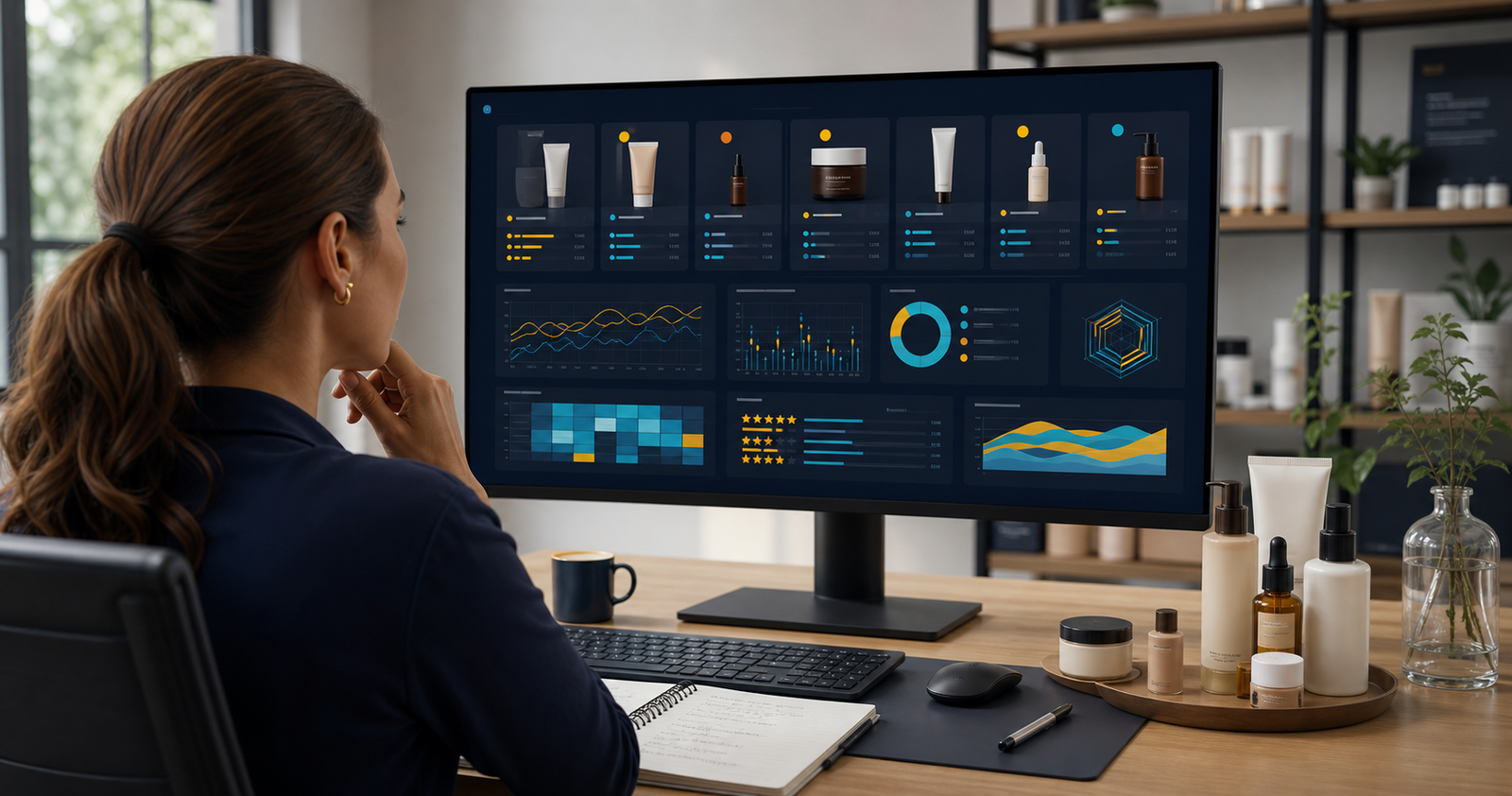
A beauty team can spend hours opening product pages, copying prices and trying to remember which competitor changed a title, bundle or claim. The strategic questions matter: Which price tier is crowded? Which complaints recur? Are larger packs winning value comparisons? Which listings improve after a reformulation?
Amazon competitor analysis for beauty brands becomes useful when observations are captured consistently over time. Octoparse offers an Amazon scraper template and a broader no-code platform that can turn permitted pages into structured records. The tool can accelerate collection; it cannot decide whether two serums are comparable or whether a review claim is scientifically valid.
Amazon's Conditions of Use restrict data mining, robots and similar extraction tools. Before automated collection, obtain permission or use an authorised API, approved data provider or manual process. This guide describes research design, not permission to scrape Amazon.
Why beauty needs category-specific analysis
Beauty competitors cannot be compared by title and price alone. A �12 cleanser may be 50 ml or 200 ml. A retinol serum may differ in derivative, disclosure, supporting ingredients and instructions. Ratings can hide a tiny sample or a formula change.
- Pack size changes price: calculate price per ml, gram, sheet or use where meaningful.
- Variant structure matters: shade, scent, skin type and bundle can share or split reviews.
- Claims need context: marketing language is not substantiated performance.
- Reviews mix experiences: formula, packaging, delivery and seller service can share a rating.
- Availability changes visibility: stock issues can distort price and rank comparisons.
Choose a narrow competitor set
Start with a product job and price neighbourhood: fragrance-free barrier moisturisers, salon-style bond repair or refillable cream blush. Include direct competitors, one aspirational brand and one high-volume value brand. Do not treat every broad-keyword result as a true alternative.
| Layer | Example fields | Decision |
|---|---|---|
| Identity | Brand, product, variant and stable ID | Deduplication and history |
| Commercial | Price, pack size, voucher and subscription | Price architecture |
| Positioning | Title, bullets, ingredients and stated use | Message and assortment gaps |
| Proof | Rating, review count and permitted claims | Evidence strength |
| Availability | Stock signal, delivery and seller | Interpret price changes |
| Provenance | URL, market and observation date | Auditability |
An Octoparse beauty-research workflow
1. Define the decision and frequency
Weekly price monitoring, quarterly assortment research and a one-off packaging review need different datasets. "Should we test a larger pack?" is more useful than "Track competitors."
2. Confirm permitted access
Review Amazon's current terms and the intended marketplace. If automation is restricted, use an authorised API or licensed provider. Do not defeat CAPTCHAs or technical restrictions.
3. Test a small product sample
Choose ten to twenty products and inspect the output. Check variants, currency, coupons, subscription prices, stock states and missing fields. A template still needs category-specific quality control.
4. Normalise units and variants
Create a standard unit while keeping the original value. Separate one-off, subscription and conditional discounts. Link shades or scents to a parent without assuming ratings belong to one variant.
5. Store snapshots
Keep a date-stamped row for each observation. Insight is often the change: price moved, review velocity increased, a bundle disappeared or the hero claim changed.
6. Add human interpretation
Tag changes as routine promotion, possible repositioning, packaging update, availability issue or unknown. Automated data should create a research queue, not trigger copying or immediate price changes.
Analyse price without racing to the bottom
Calculate like-for-like unit price and map products by proposition as well as price. A premium formula with different ingredients, packaging and channel strategy may not need to match a value alternative.
Useful signals include median unit price, promotional frequency, subscription discount, bundle economics and the share of products in each band. Test changes against margin, conversion and repeat purchase.
Turn reviews into a useful taxonomy
Reviews can reveal language, but they are noisy and may contain sensitive or copyrighted content. Collect only what the permitted method and licence allow. Store identifiers and coded themes rather than republishing large passages.
- texture and absorption;
- scent and sensitivity;
- shade or colour accuracy;
- packaging leakage, pump or closure;
- instructions and ease of use;
- perceived results and time to result;
- value, quantity and repeat purchase;
- delivery or seller issues that are not product issues.
Code positive and negative mentions. Review a sample manually and avoid turning anecdotes into medical or efficacy statements. Reports of irritation are a safety and support signal for expert review, not marketing copy.
Find listing opportunities without copying
Look for unclear pack size, missing application guidance, confusing variants, unanswered compatibility questions and packaging complaints your design genuinely solves. Have regulatory and legal reviewers approve cosmetic claims, comparisons, ingredients and imagery. Marketplace research does not replace substantiation.
A weekly beauty intelligence dashboard
| View | Signal | Action |
|---|---|---|
| Price | Large unit-price change | Check whether it is temporary or conditional |
| Assortment | New size, shade, bundle or formula | Assess the customer job and range gap |
| Message | Title, bullet or image-theme change | Record the hypothesis and monitor |
| Reviews | Theme frequency or rating shift | Separate product from fulfilment issues |
| Availability | Stock or seller change | Avoid misreading a temporary event |
What Octoparse does and does not solve
The Amazon template can shorten a permitted extraction setup, while the main platform suits custom workflows for other authorised sources. It does not provide permission, guarantee complete data, resolve variant ambiguity, validate cosmetic claims or determine strategy.
A small brand running occasional research may be better served by manual checks or an approved analytics tool. A team with repeated fields and a lawful data route has a stronger case for no-code extraction.
A responsible 30-day pilot
- Week 1: choose one subcategory, define decisions and confirm the authorised route.
- Week 2: collect a small sample, resolve variants and validate fields.
- Week 3: create unit-price, history and review-theme views with manual QA.
- Week 4: select one listing, packaging or assortment hypothesis and measure it.
See our price-monitoring guide, commercial cleaning prospecting and B2B SaaS voice-of-customer research.
Frequently asked questions
Can a beauty brand scrape Amazon competitor data?
Do not assume so. Amazon's conditions restrict data mining and extraction tools. Confirm permission or use an authorised API, licensed provider or manual process.
What fields are useful for beauty competitor analysis?
A stable product ID, variant, pack size, price type, unit price, rating, review count, availability, seller, source URL and observation date can be useful, subject to permission.
How should beauty brands compare product prices?
Normalise by ml, gram, sheet or estimated use where meaningful, and separate one-off prices from subscriptions, vouchers and bundles.
Can customer reviews be reused in marketing?
Not automatically. Reviews may be copyrighted, personal and governed by marketplace terms. Use aggregate research and quote only with appropriate rights.
Does Octoparse replace an Amazon analytics platform?
No. Octoparse structures permitted web data. It does not provide permission, retail-media data, complete sales estimates or claim substantiation.